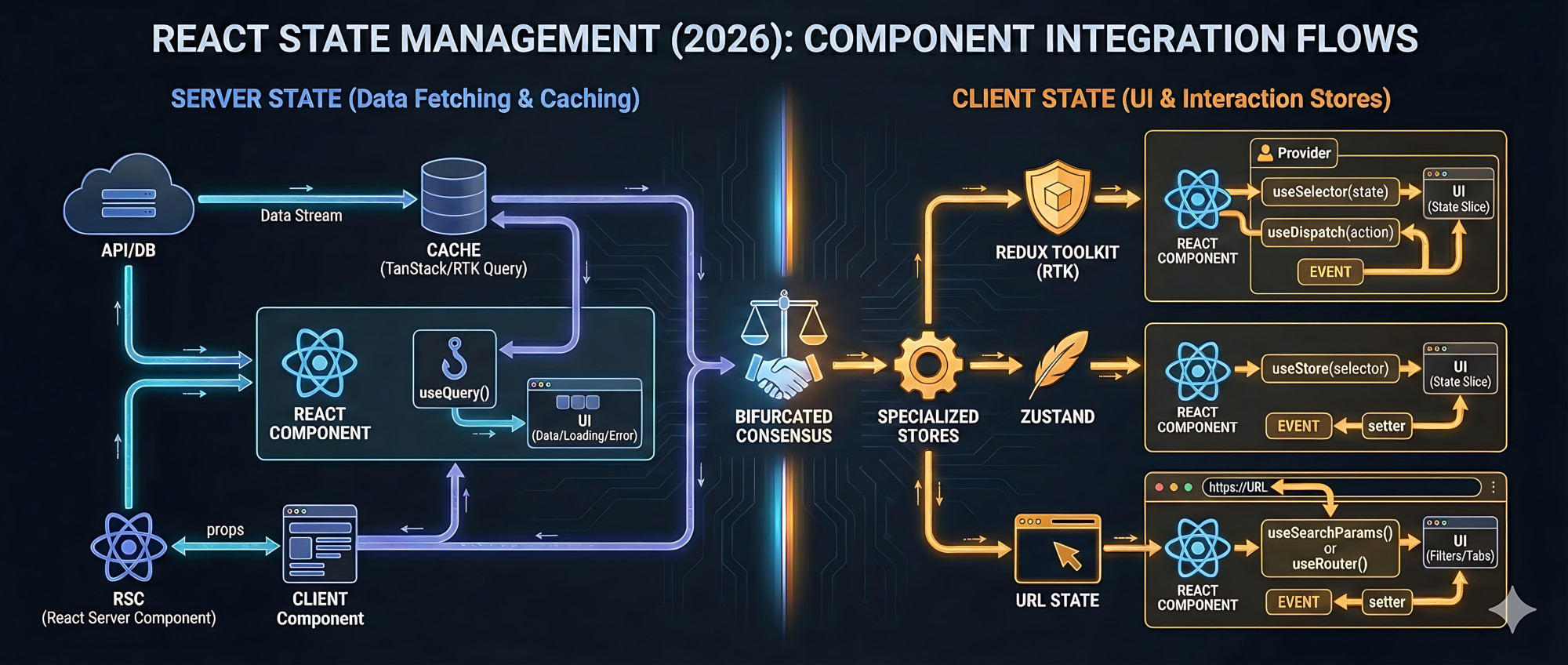
React State Management in 2026
The Bifurcated Consensus: React State Management in 2026
The "State Management Wars" of the early 2020s—a chaotic era where developers endlessly debated Redux vs. Context vs. Recoil—are effectively over.
By 2026, the React ecosystem has settled into a Bifurcated Consensus.
We have stopped looking for a "silver bullet" monolithic store and instead embraced a separation of concerns: Server State (data) and Client State (UI).
This shift has not only calmed the ecosystem but also drastically reduced the amount of code developers write.
I decided to make a little bit of a research regarding this problem and share my findings here.
1. The Server State Revolution: The "Code reduction" Time
A critical realization in the 2020-2026 period was that data originating from an API is not "state" in the traditional sense—it is a cache.
In older React versions up to 2021, developers treated API responses like local variables, writing massive amounts of Redux boilerplate (action creators, thunks, reducers) just to track loading, error, and success flags.
The New Standard: Async State Managers
Currently, as of January 2026 when I am writing this material,
TanStack Query (formerly React Query) and RTK Query(Redux Toolkit Query) are the de facto standards.
These libraries treat server data as a resource to be cached, deduplicated, and invalidated, rather than state to be "managed."
Impact: Adopting these tools allows teams to delete 30-50% of their legacy Redux code.
The Next Step (RSC): The evolution didn't stop at client-side fetching. With the maturity of React Server Components (RSC) in frameworks like Next.js, much of this "state" now never leaves the server. Data is fetched directly in the component on the server, and only the rendered HTML is sent to the client, eliminating the need for client-side fetch logic entirely for initial loads.
2. Client State: The Heavyweight vs. The Ninja
With API data handled by Query libraries or RSC, what is left for the client? This is where the consensus splits into two distinct paths, depending on the architecture's complexity: Redux Toolkit and Zustand.
Redux Toolkit (RTK): The Enterprise Standard
RTK is the "batteries-included" evolution of Redux. It is no longer the verbose beast of 2018. It uses Immer (Tiny package that allows you to work with immutable state in a more convenient way) internally, allowing developers to write mutating logic (e.g., state.value = 123) that is safely converted to immutable updates under the hood.
- Best For: Large-scale enterprise apps, complex multi-step wizards, and teams where strict architectural enforcement is necessary.
- Superpower: The Redux DevTools and "Time Travel" debugging remain unmatched for tracing complex state flows in financial or logistical software.
Zustand: The Minimalistic Favorite
Zustand emerged as the counter-culture to Redux. It is tiny (~1KB), hook-based, and requires no Context Providers.
- Best For: Startups, rapid prototyping, and 80% of standard CRUD applications.
- Superpower: The "Transient Update" model. Zustand allows components to subscribe to specific slices of state without triggering re-renders in the entire component tree—solving the major performance bottleneck of React Context.
3. Code Showdown: The Shopping Cart
To illustrate the difference in developer experience (DX), let’s look at a shopping cart implementation. This comparison highlights the tension between Structure (Redux) and Agility (Zustand).
Implementation A: Redux Toolkit (Structured)
The logic is split between a "slice" and a store configuration. It is verbose but highly testable and strict.
TypeScript
// features/cart/cartSlice.ts
import { createSlice, PayloadAction } from '@reduxjs/toolkit';

const cartSlice = createSlice({
  name: 'cart',
  initialState: { items: [], total: 0 },
  reducers: {
    addItem: (state, action: PayloadAction<CartItem>) => {
      // RTK uses Immer: We can "mutate" state directly!
      const existing = state.items.find(item => item.id === action.payload.id);
      if (existing) {
        existing.quantity += 1;
      } else {
        state.items.push({ ...action.payload, quantity: 1 });
      }
      state.total += action.payload.price;
    },
    // ... removeItem logic
  },
});
Implementation B: Zustand (Concise)
The store and hook are one entity. It is 40% shorter but requires manual discipline regarding immutability.
TypeScript
// stores/useCartStore.ts
import { create } from 'zustand';

export const useCartStore = create((set) => ({
  items: [],
  total: 0,
  addItem: (newItem) => set((state) => {
    // Manual immutability required here (unless using middleware)
    const existing = state.items.find(item => item.id === newItem.id);
    // ... logic to copy array and update item
    return {
        items: newItems,
        total: state.total + newItem.price
    };
  }),
}));
4. The Third Player: URL as State
An important extension to the reality of React in 2026 is the resurgence of URL State.
For UI state that should survive a page refresh (like search filters, pagination, or active tabs), developers are increasingly bypassing both Redux and Zustand in favor of the URL. Libraries like nuqs (Next.js URL Query Strings) allow you to treat the URL query parameters as a state store.
Why? If a user shares a link someapp.com/dashboard?tab=analytics&dateFrom=2026.01.01&dateTo=2026.01.31, the app renders the exact same state for the recipient. Redux or Zustand cannot do this easily without complex hydration logic. However for the bigger infrastructure, that hybrid solution is a very correct one.
It makes a lot of sense while using tools like for example Dynatrace or Data Dog, so just by sending the URL you can share with the team the exact context you intend to,
as long as your colleague has access to it.
Summary
If you are starting a project today, or you are during preparation phase, battling with dilemmas of most adequate architecture for your needs, here is how the community consensus suggests you manage your data:
| Type of State | Definition | Recommended Tool (2026) |
| Server State | Data from API (User profile, Products) | TanStack Query or React Server Components |
| Global Client (Complex) | Interdependent data (Editor, FinTech) | Redux Toolkit |
| Global Client (Simple) | Sidebar open/close, Auth User, Cart | Zustand |
| Shareable UI | Filters, Pagination, Tabs | URL Search Params (e.g., nuqs) |
| Form State | Inputs, Validation | React Hook Form (Local state) |
We didn't choose one winner
yet again we have to choose the right tool for the right job.
There is no Jack of all trades.